PLEASE NOTE: The blog contains quite a few pictures so give it several minutes to download. They download haphazardly.
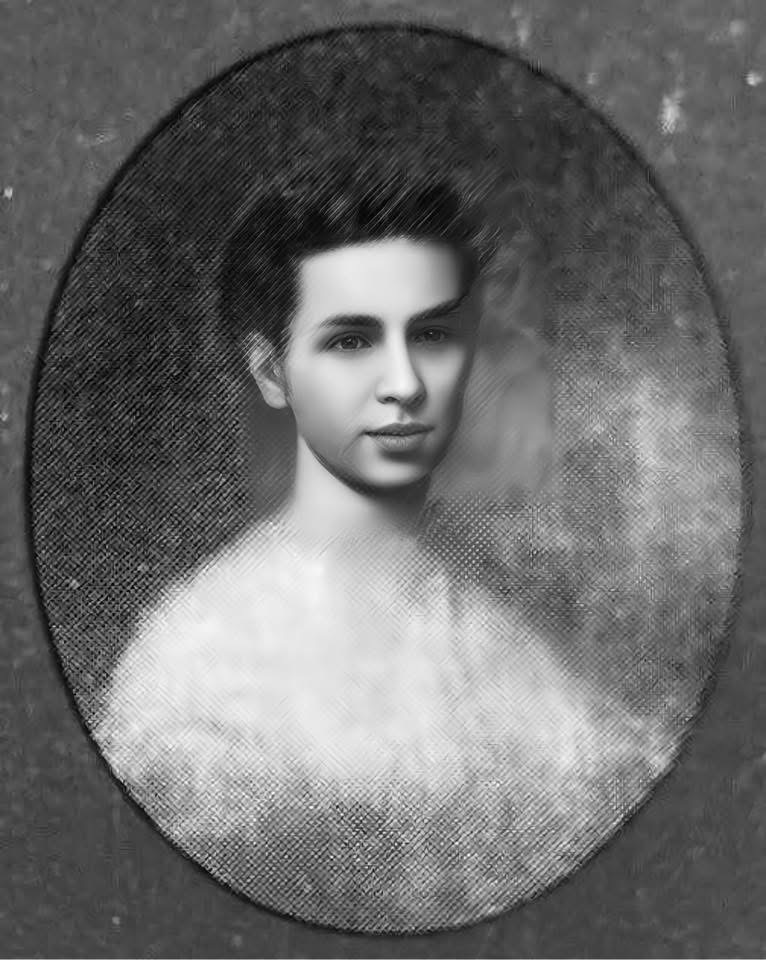
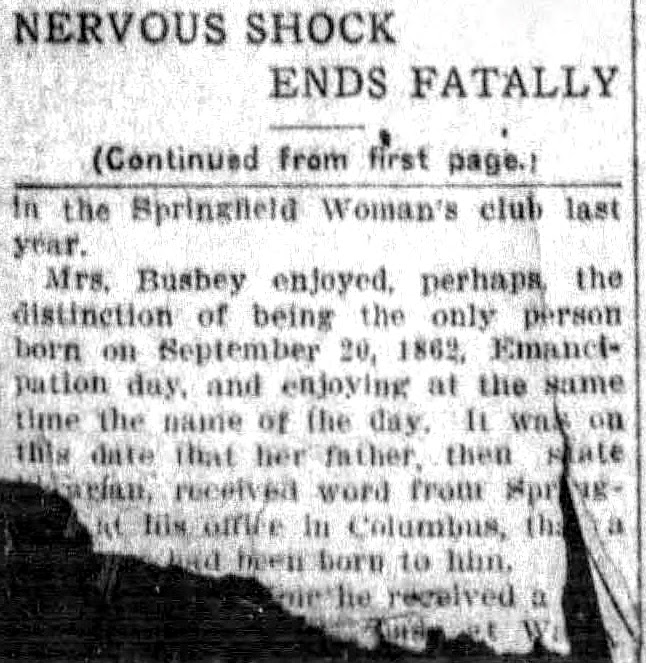
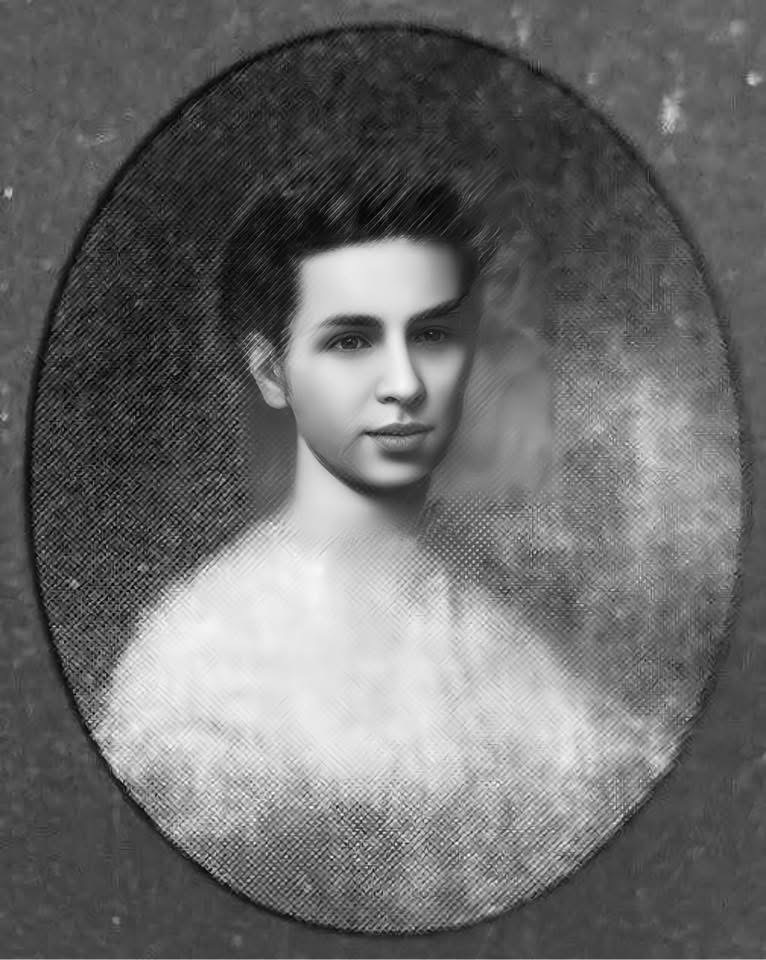
On September 20 of 1862, President Lincoln read to his Cabinet the final draft of his Emancipation Proclamation. It declared that effective January 1 of 1863 enslaved people in those states rebellious to the Union were forever free. At almost that very minute, a daughter was born to William and Mary Coggeshall of Springfield where William was owner/editor of the Springfield Republic newspaper. Secretary of the U.S. Treasury/former Ohio Governor Salmon P. Chase telegraphed Lincoln’s news to William who had served as secretary for Chase when he was governing Ohio. William, a staunch supporter of Lincoln, had a name in mind for the newborn to honor this occasion. He decided to withhold it until the Confederate capital of Richmond fell. When that happened two and a half years later in 1865…Emancipation Proclamation Coggeshall became official. As later stated by E.P. herself, “In those two-and-a-half years that I was nameless, what did the family call me? “Baby” and “Girlie.” Mama called me “Girlie” even into adulthood. Then, after I was christened Emancipation Proclamation they called me “Prockie.” So did everyone else, for the rest of my life.”
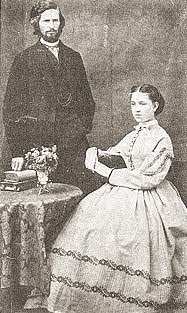
The Coggeshalls moved to Columbus in 1865 when William became editor of the Ohio State Journal (The Columbus Dispatch later succeeded it). He died of tuberculosis in Ecuador in 1867 a year and one day after being appointed U.S. Minister to that country. William’s decision to take the appointment was based on hope that the environment there might be a cure for the TB from which he was suffering. Mary and daughters Hattie and Prockie remained in Columbus after his death.
In 1877 the widowed Mary was appointed postmistress of Westerville. Hattie and Prockie attended the preparatory school at Otterbein University for one year with Prockie continuing through her sophomore year.
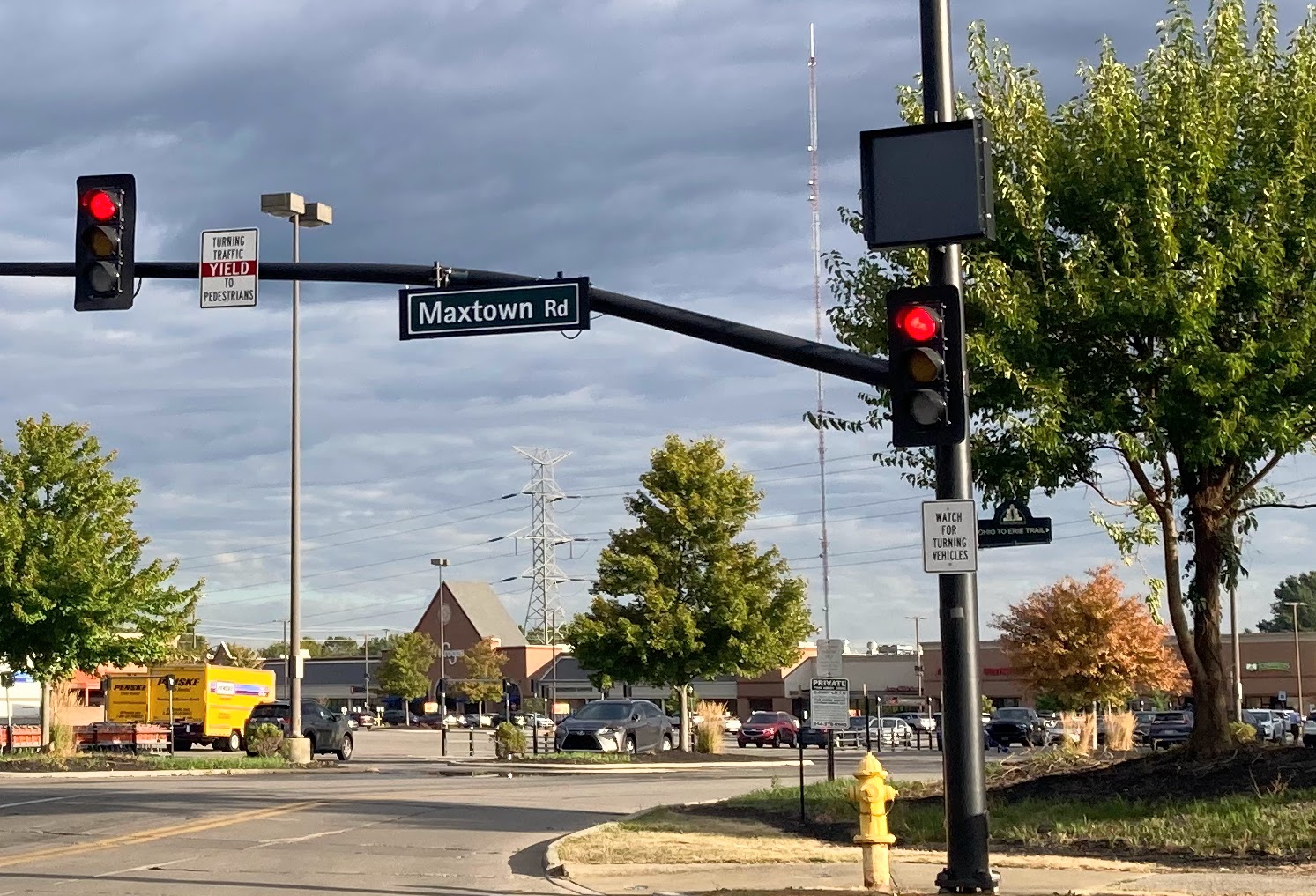
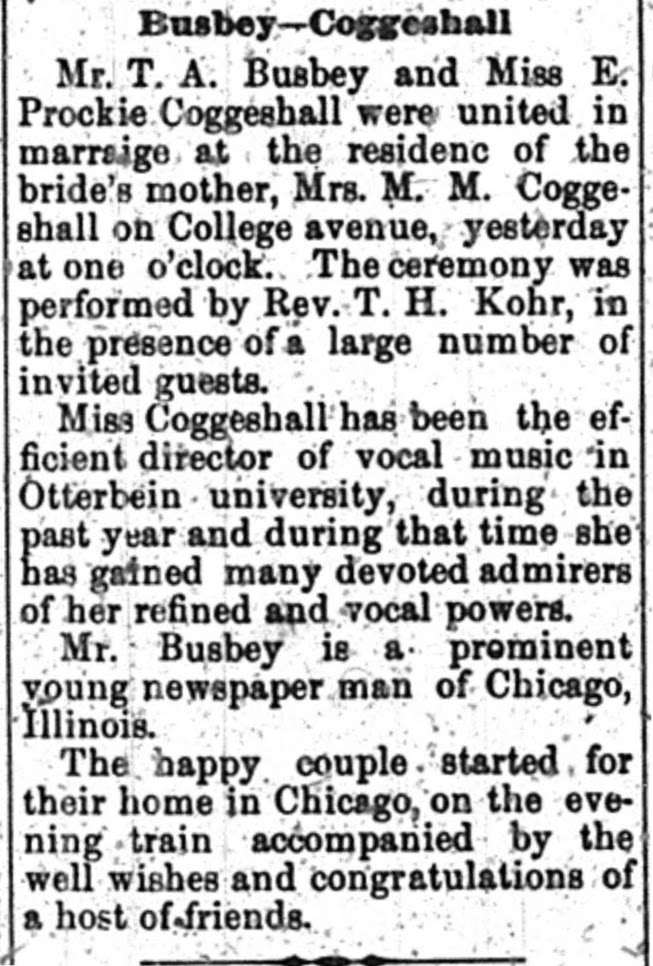
The 1880 U.S. Census listed Prockie and Hattie as assistants to their mother at the post office. In that capacity Prockie became connected to “Maxtown” as revealed further down in this blog. She was known in Westerville for her soprano singing voice. The unexpected death of Otterbein professor William Zuzerne Todd in August of 1887 led to her replacing him as vocal music instructor. At the close of the academic year in 1888, Prockie married Thomas Addison Busbey of South Vienna (Clark County), Ohio.
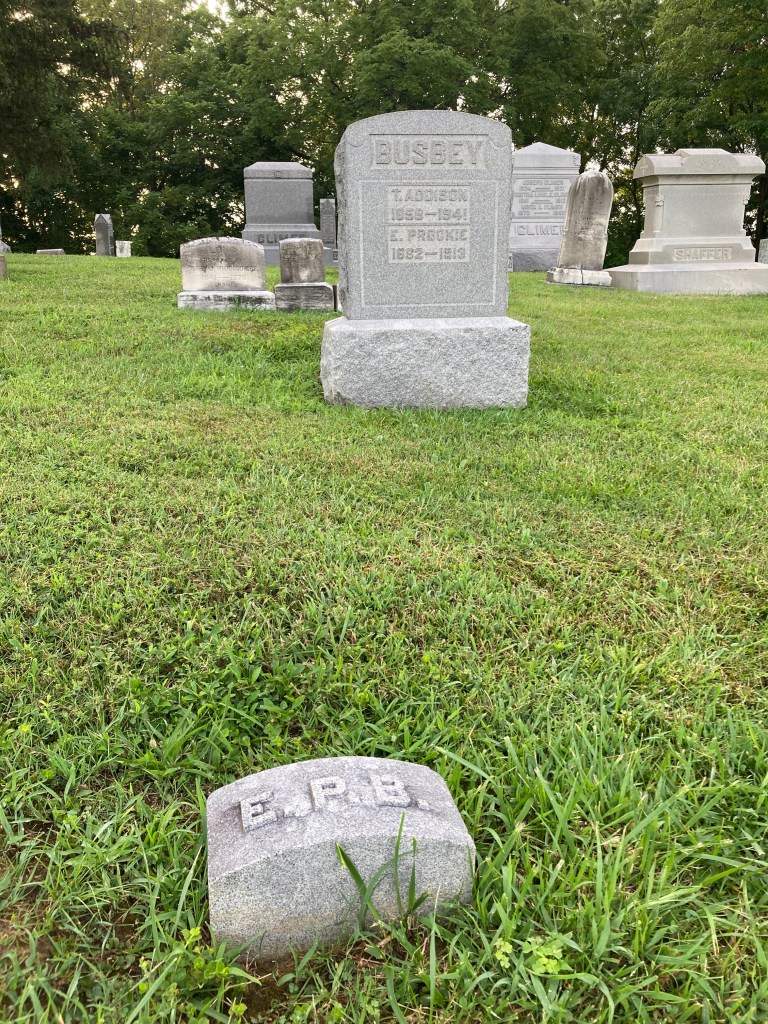
The newlyweds resided in Chicago for twenty years. Addison was a journalist/newspaper editor in that city. Prockie sang professionally with the Theodore Thomas Orchestra which was later renamed the Chicago Symphony Orchestra. A son, Ralph, was born in 1890.
The Busbeys returned to Ohio and South Vienna in 1908. Addison had an insurance business, served four terms as South Vienna mayor and then became a State Senator. Ralph became a journalist/newspaper editor like his father. Prockie was in demand as a singer. “Everywhere I performed, whether at banquets, receptions, state functions, patriotic meetings or political rallies, I aroused great patriotic response because of my name, the diplomatic role my Father had, and because I ended my concerts with “The National Jubilee Song.”
The Prockie quotations in the first and last paragraphs are from Civil War Heroines, The Coggeshall Ladies. The National Jubilee Song was associated with the Civil War which would explain the reference to Civil War Heroines.
10/18/2025 donfoster73@gmail.com
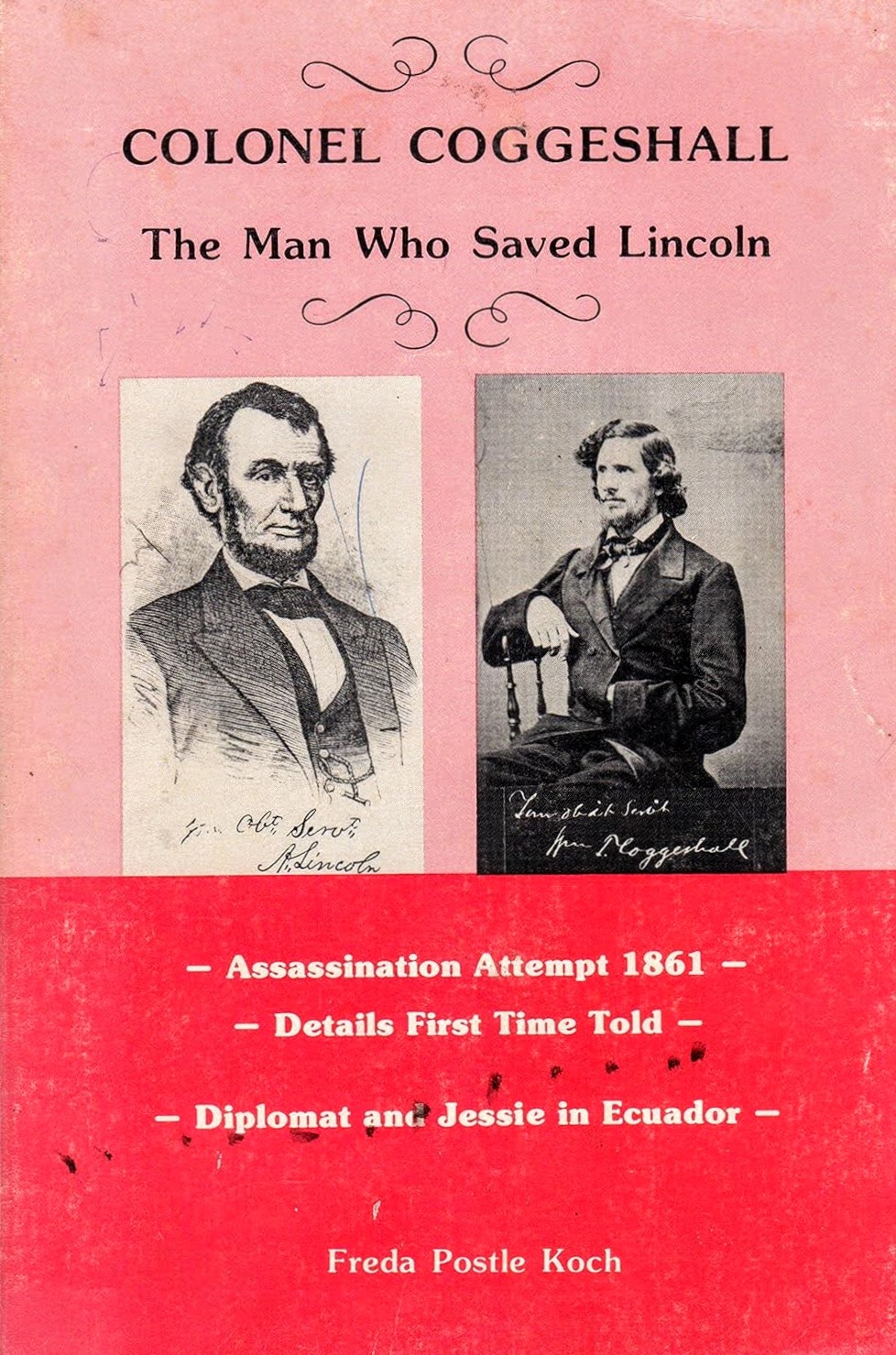
The man who saved Lincoln.
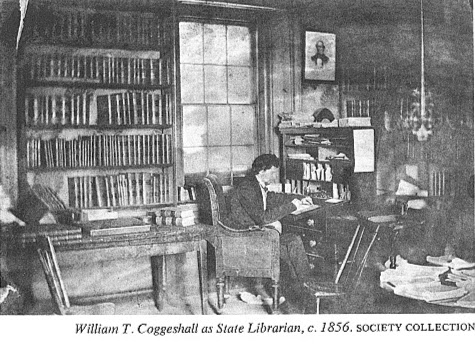
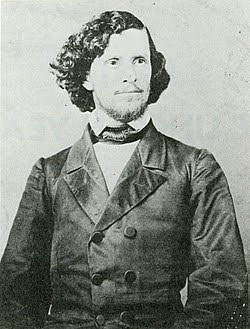
William Turner Coggeshall served as secretary to Ohio governors Salmon Chase and William Dennison. He also served a term as State Librarian.
The train taking President-elect Lincoln to Washington for his inauguration made a stop in Columbus. Governor Dennison appointed Coggeshall to escort Lincoln to the statehouse. From there, Coggeshall served as a bodyguard and rode with Lincoln the rest of way. Many years later, Mrs. Coggeshall wrote that at a stop in Harrisburg, Pennsylvania, “they heard a hissing sound and discovered a hand grenade just ready to explode. As Mr. Lincoln reached the door, Mr. Coggeshall grasped the shell and hurled it through the open window where it had been dropped into the car. As it struck beyond the tracks and exploded, no one was hurt. He sprang into the car where the President awaited him. They took a seat together and with a bound the car leaped forward. Neither spoke for some minutes. Then the President leaned forward and said ‘Did I not tell you I should go safely if you went with me.’”
William’s daughter Bessie, age 15, accompanied her father to Ecuador to serve as his secretary. She remained in Ecuador after he died and basically assumed his position. She longed to return home. On the night before the journey to Ohio was to begin, she developed yellow fever and died there. Years later her mother wrote “Died in the line of duty for her country at the age of 16. She was spunky, she was independent, she was a brilliant writer, she was a lady, had elegant manners and was mature beyond her years. Of how many teenagers can this be said”?
Widowed Mary, Hattie and Prockie move to Westerville.
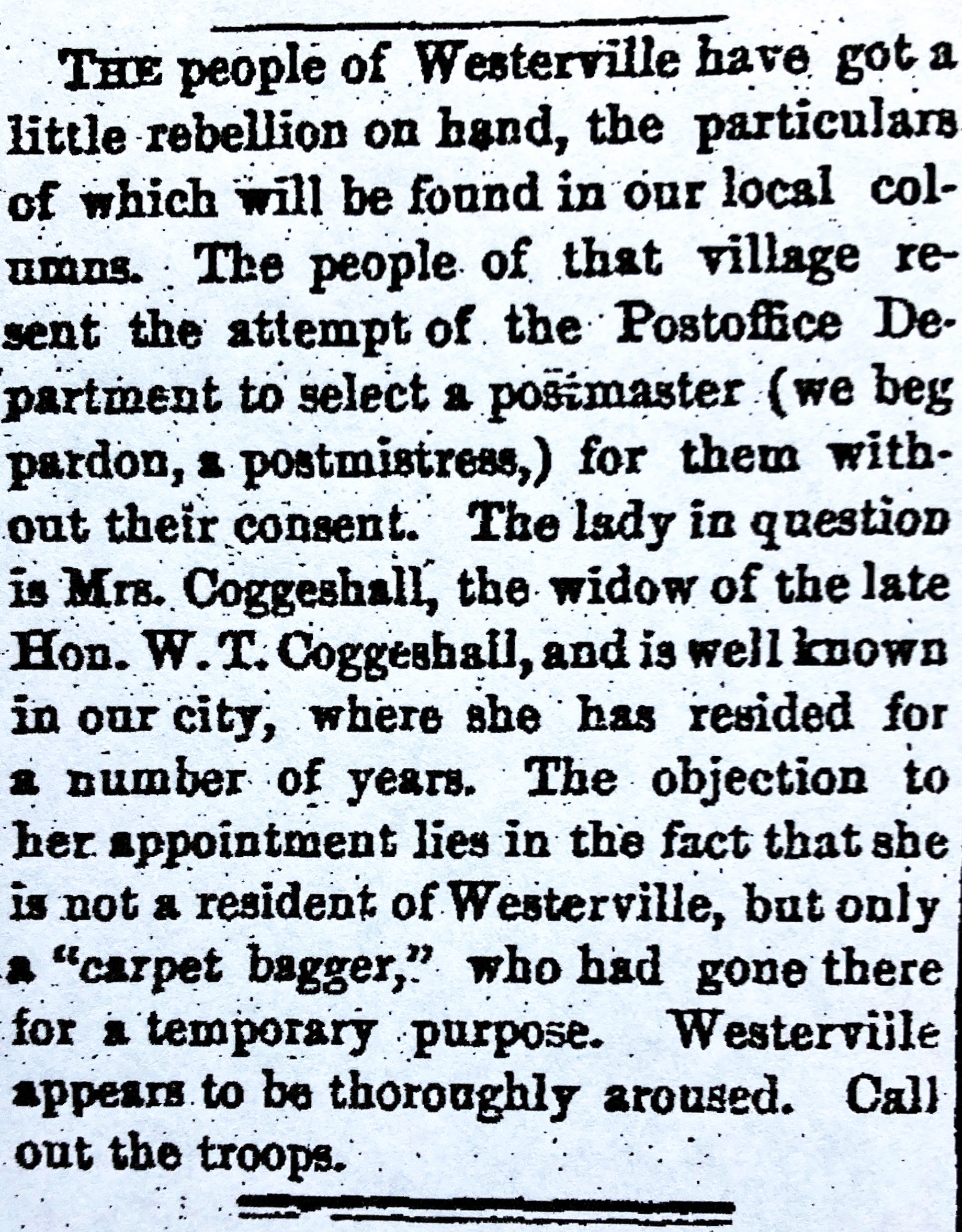
Mary’s appointment initially caused an uproar. She became very will liked in the village. The Columbus Dispatch 8/23/1877.
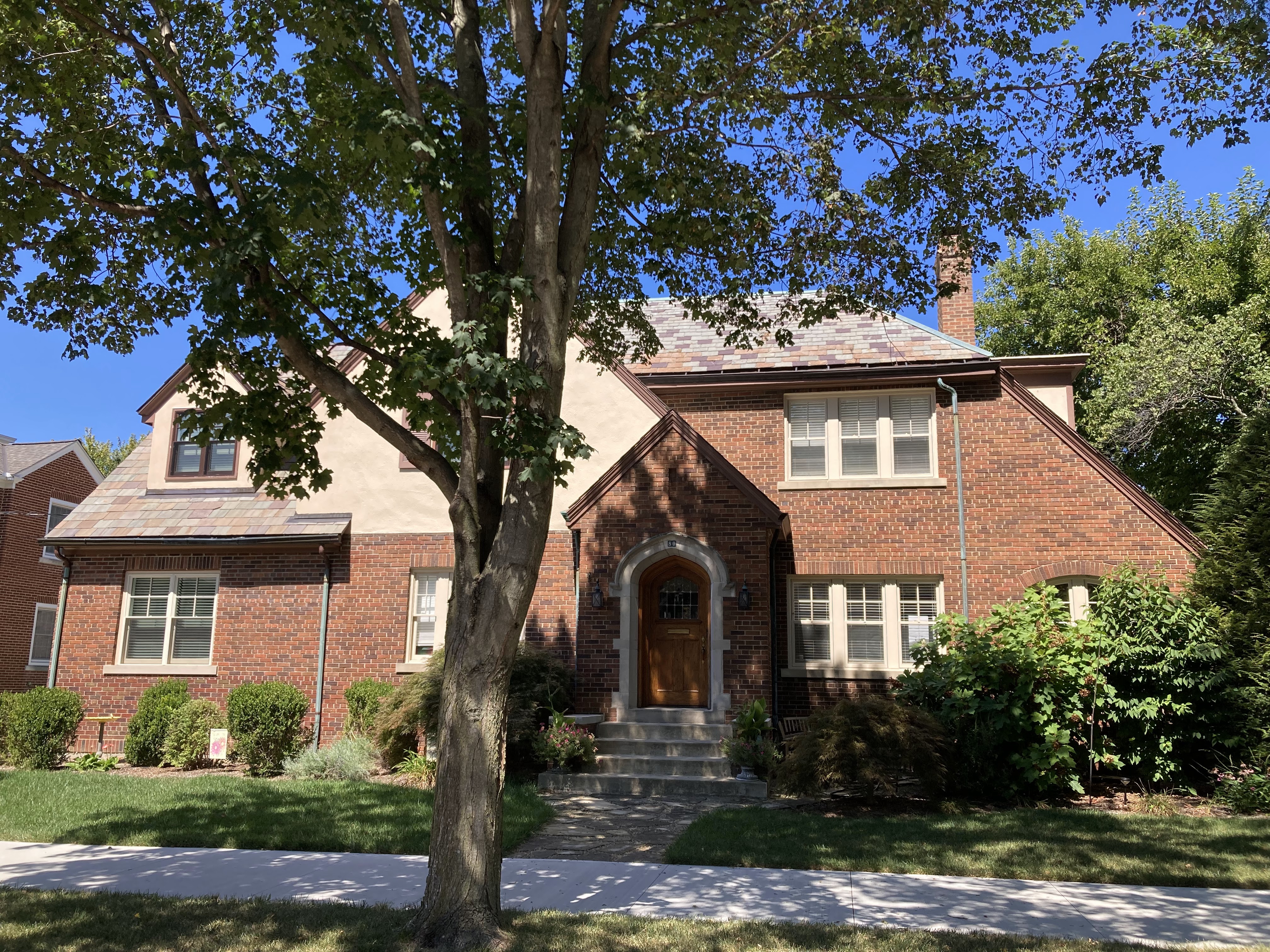
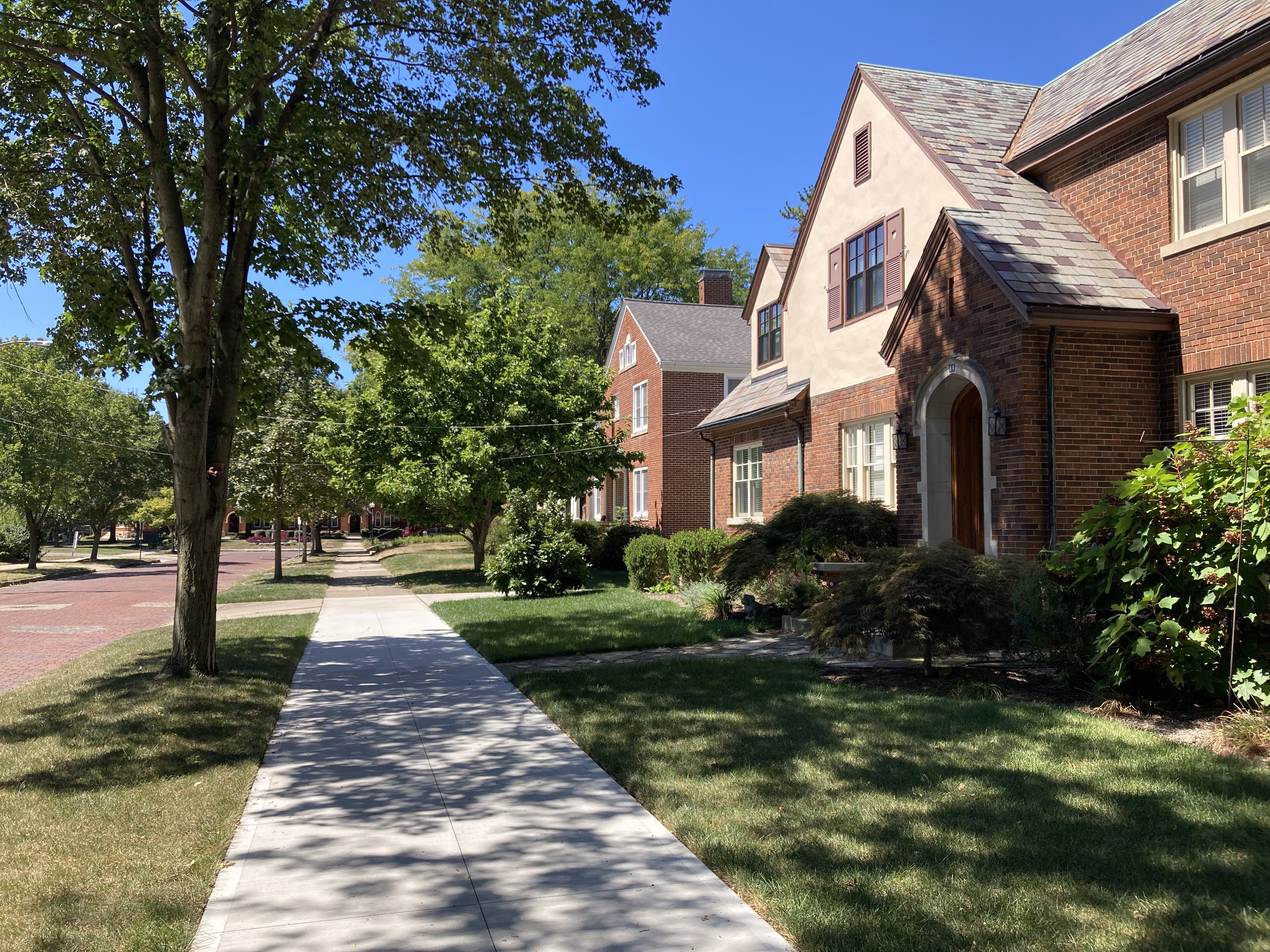
A deed to a house located on this lot was transferred from Isaac and Prudence Kingsley to Mary Coggeshall on 12/31/1879. The footprint of a house appears here on an 1866 map of Westerville. It was razed in 1927 by later owners Frederick and Emma Thomas to build the house pictured.Another view of 80 West College Avenue. Towers Hall on the Otterbein University campus is in the background.
Prockie and Hattie enrolled in the Preparatory school at Otterbein.
The Summit County Beacon (Akron) 8/18/1875.
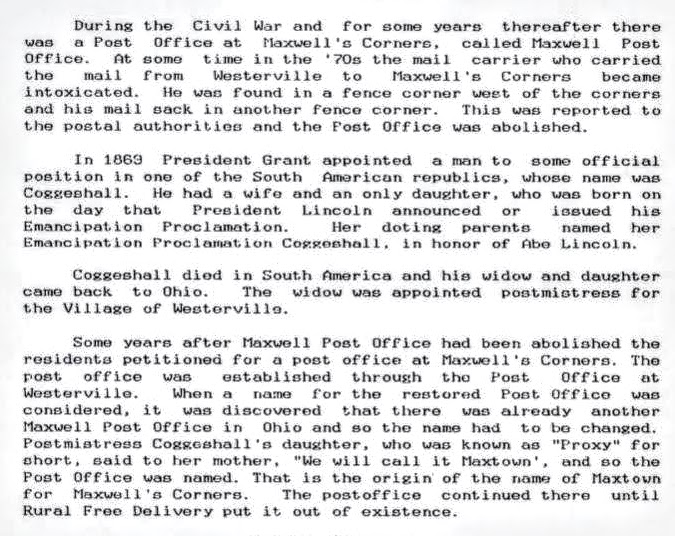
“We will call it Maxtown.”
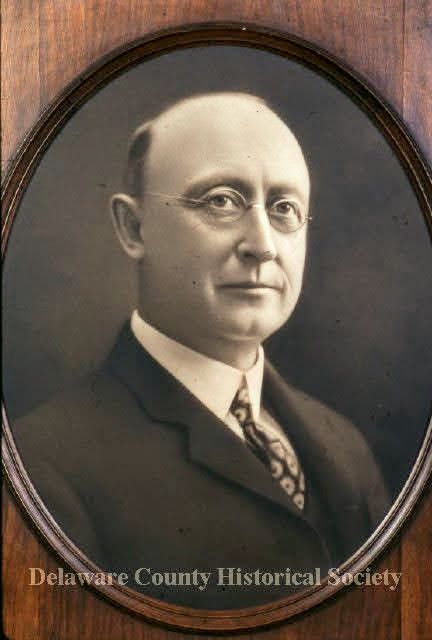
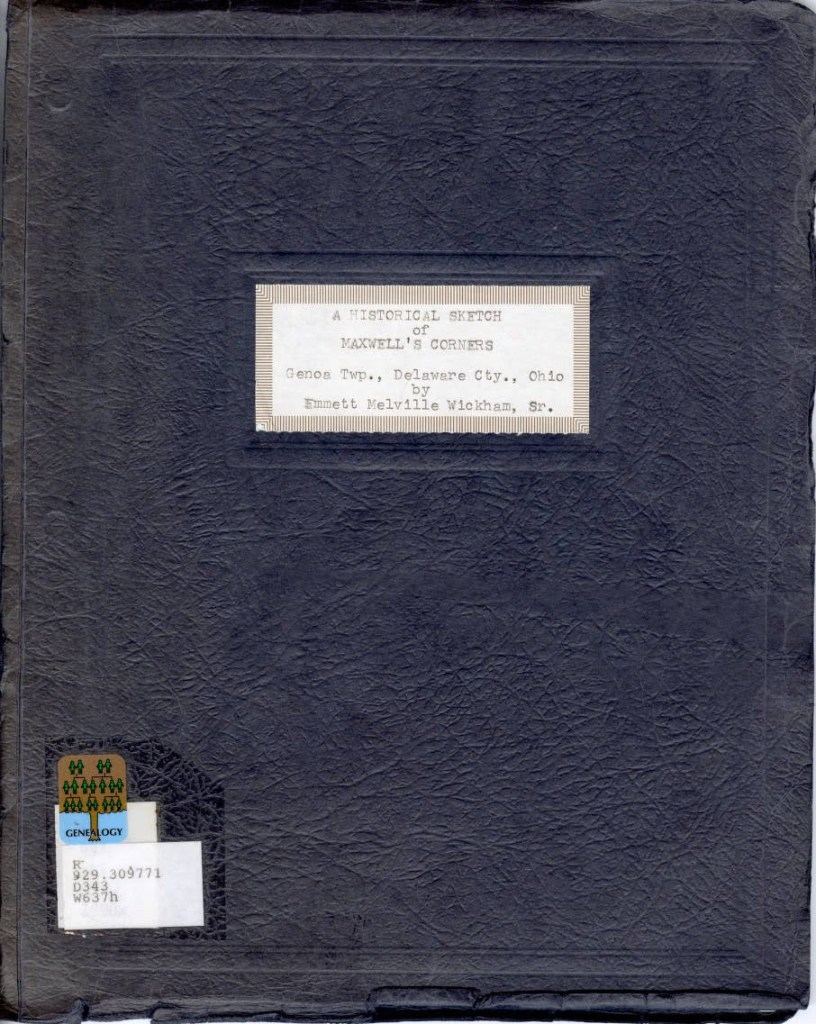
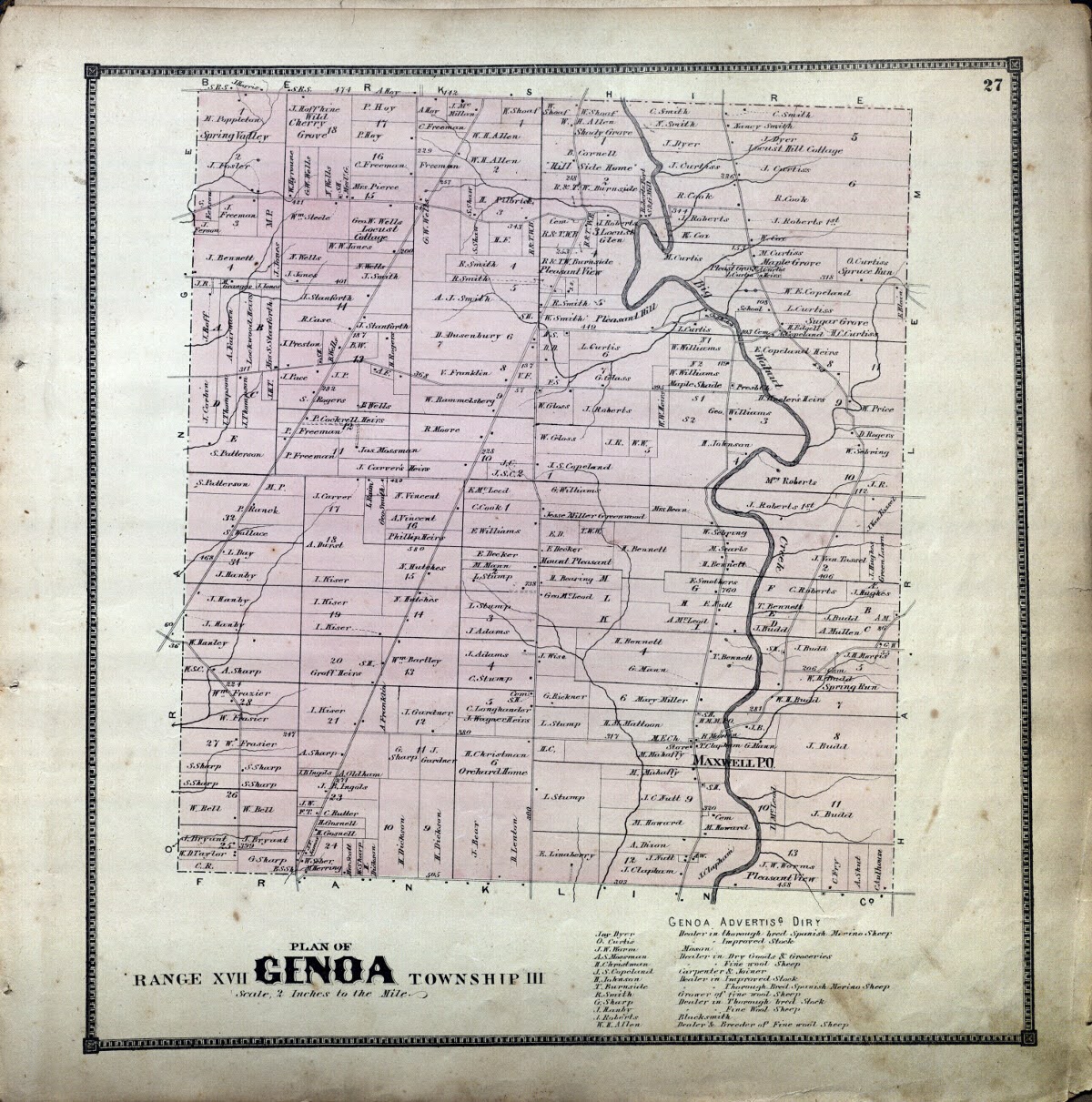
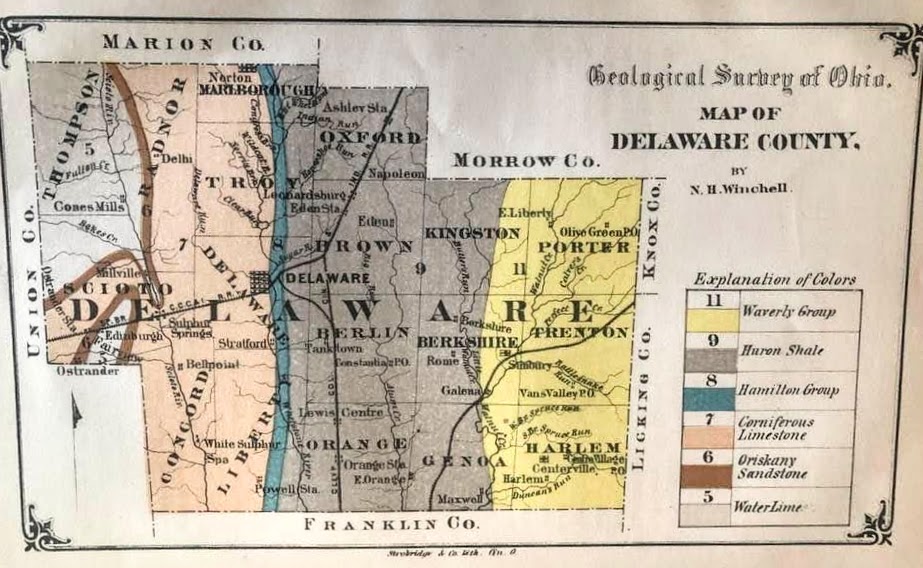
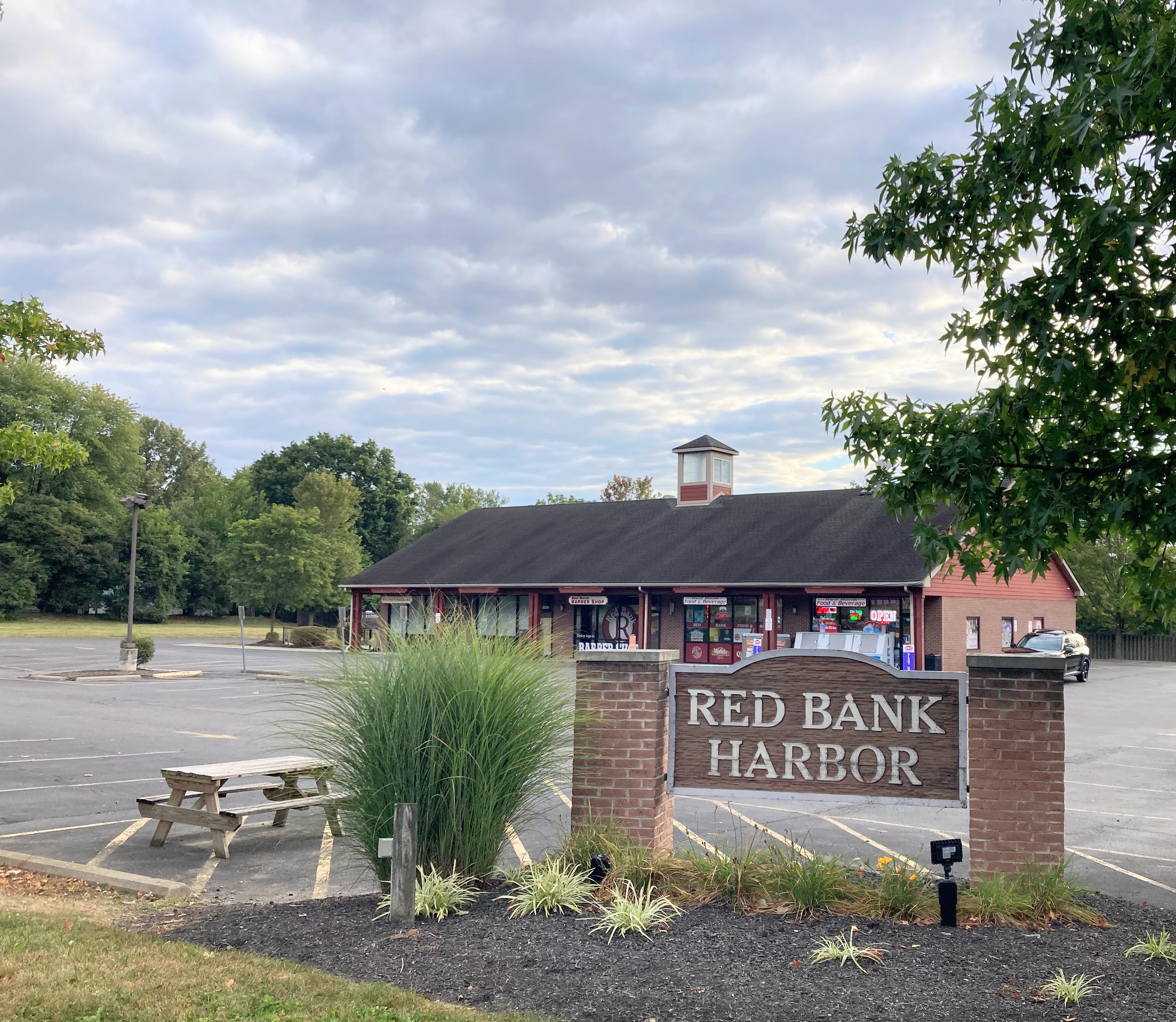
This is a page from the history of Genoa Township shown below. “Proxy” is not quite accurate.This is NOT the intoxcated mail carrier. 🙂 In 1941, Judge Emmett Melville Wickham, Sr (born in 1859) wrote his reflections of growing up in the area of Maxwell’s Corners. Judge Wickhan is interred at Oak Grove Cemetery in Delaware. Photo credit, left: Find-a-Grave. Photo credit, right: Ohio History Connection.Map is 1866. Note “MAXWELL PO” in bold print in the lower right-hand corner. The Maxwell post office existed from 1850-1871. It’s replacement, the Maxtown post office, existed from 1883-1901.This is also from Judge Wickham’s history.Another map showing Maxwell in Genoa Township.Today the area once referred to as Maxwell’s Corners is in the vicinity of this building…plus extending beyond it and now beneath Hoover Reservoir.
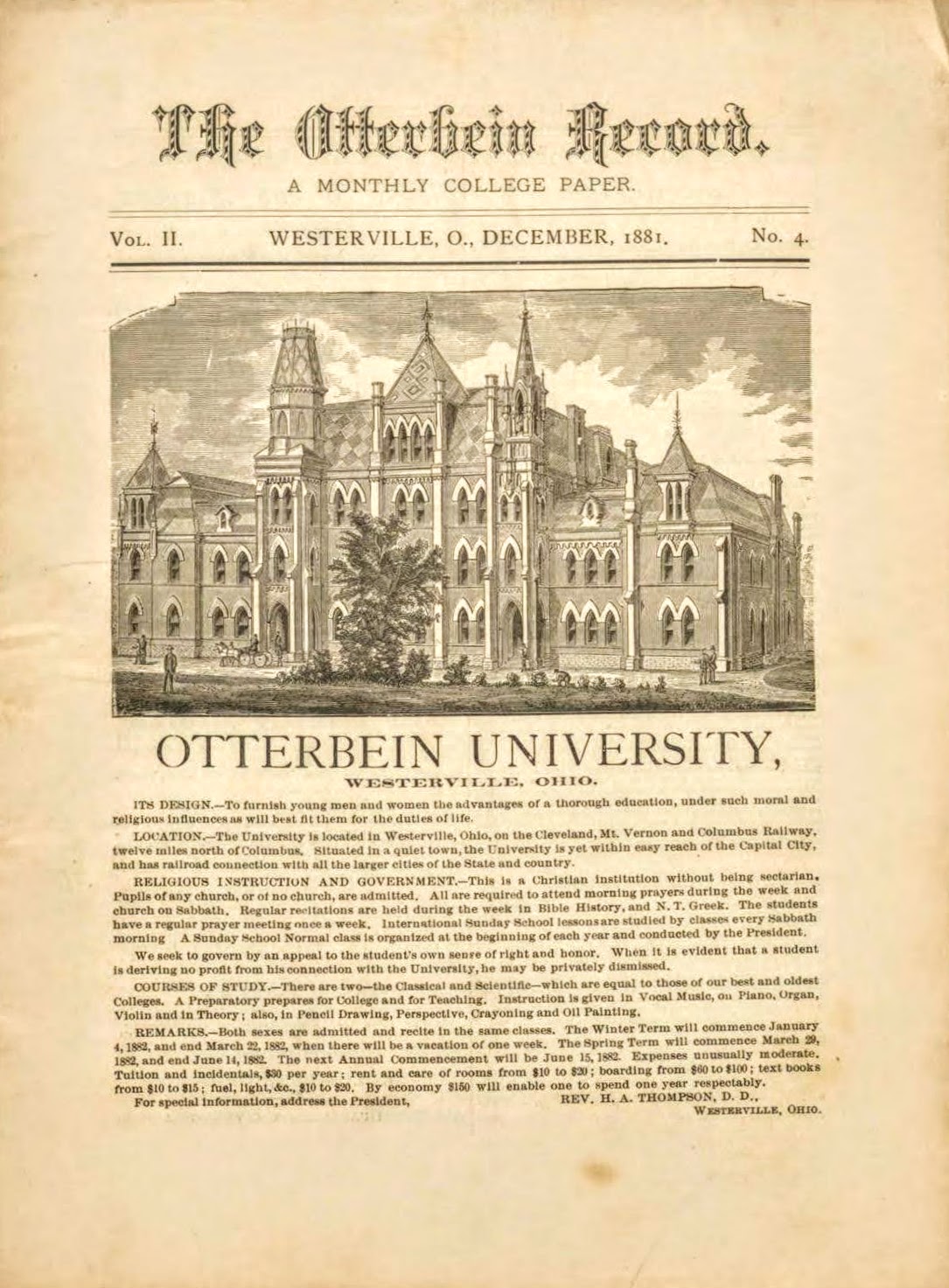
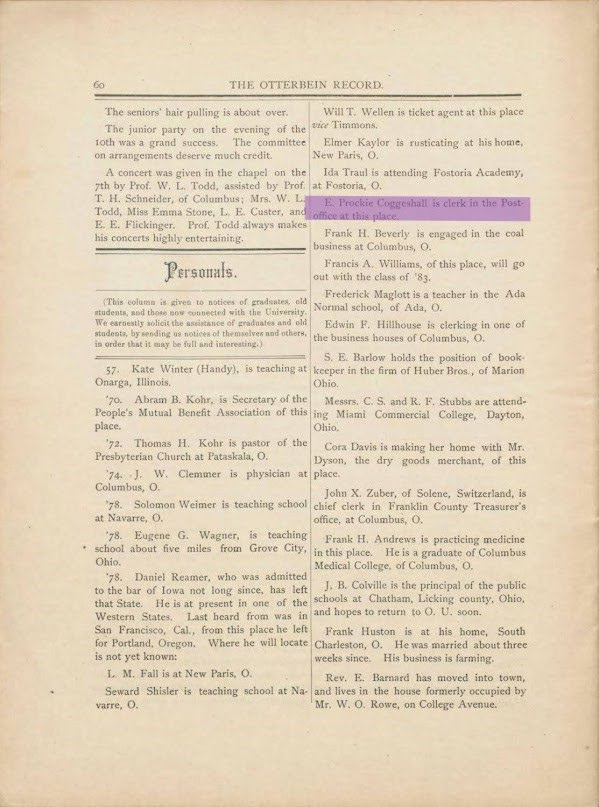
Prockie attended Otterbein through her sophomore year of 1880/81. The page below is from The Otterbein Record of 12/1881 pictured above. Photo credit: Otterbein Digital Commons.
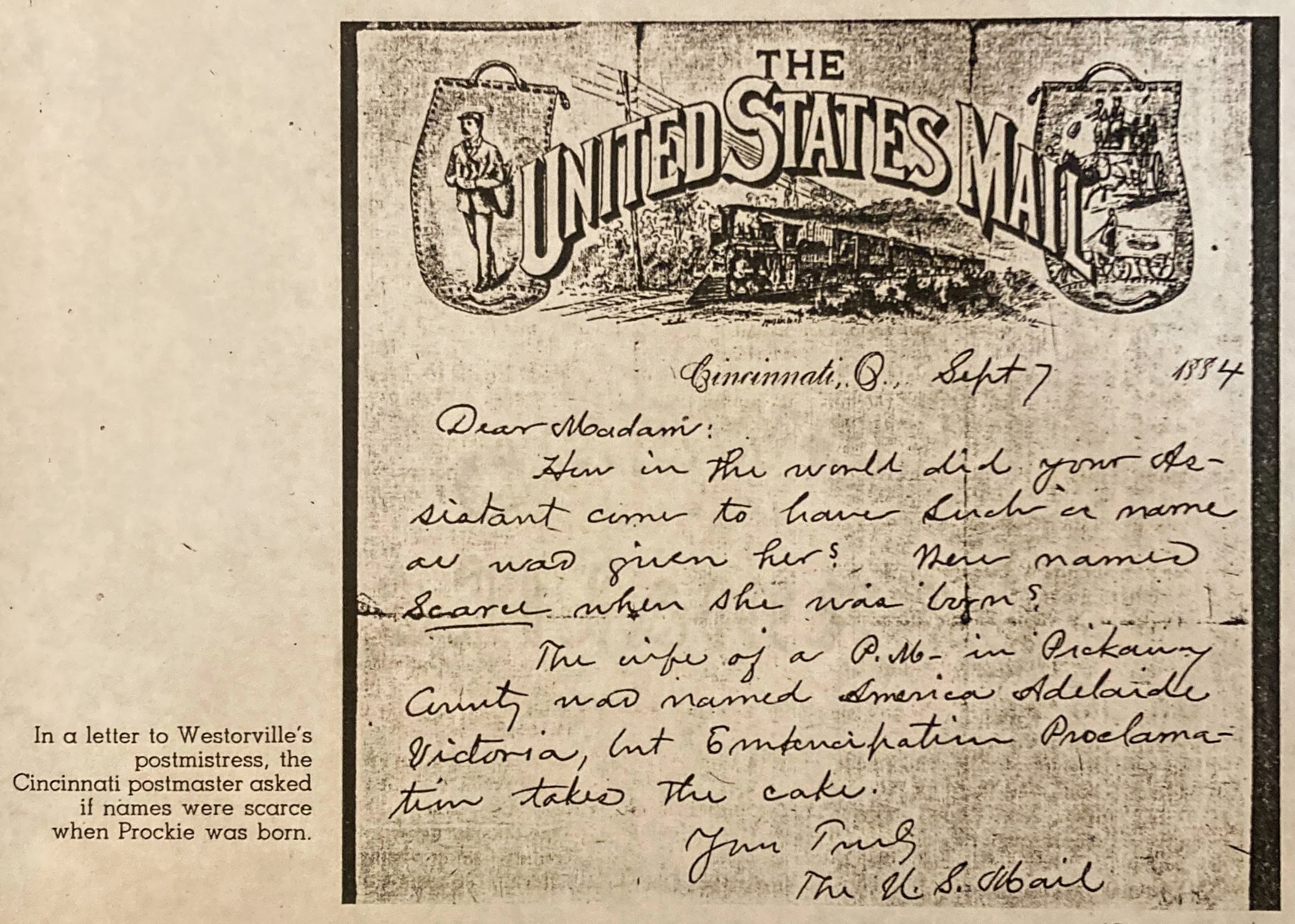
This humorous letter of 9/7/1884 from the Cincinnati post office to the Westerville post office reads: “Dear Madam: How in the world did your Assistant come to have such a name as was given her? Were names scarce when she was born? The wife of a P.M. in Pickaway County was named Adelaide Victoria, but Emancipation Proclamation takes the cake. Yours Truly, The U.S. Mail.” Photo credit: Westerville History Museum.
From Westerville to Chicago in 1888. To South Vienna, Ohio, in 1908.
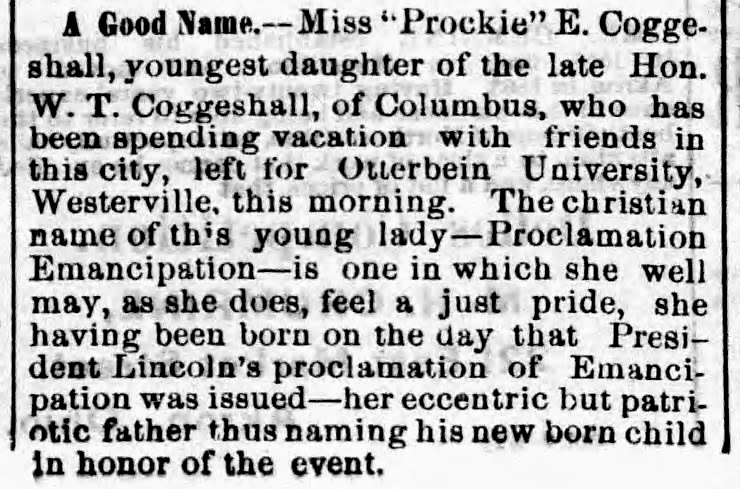
Public Opinion (Westerville) 6/29/1888.
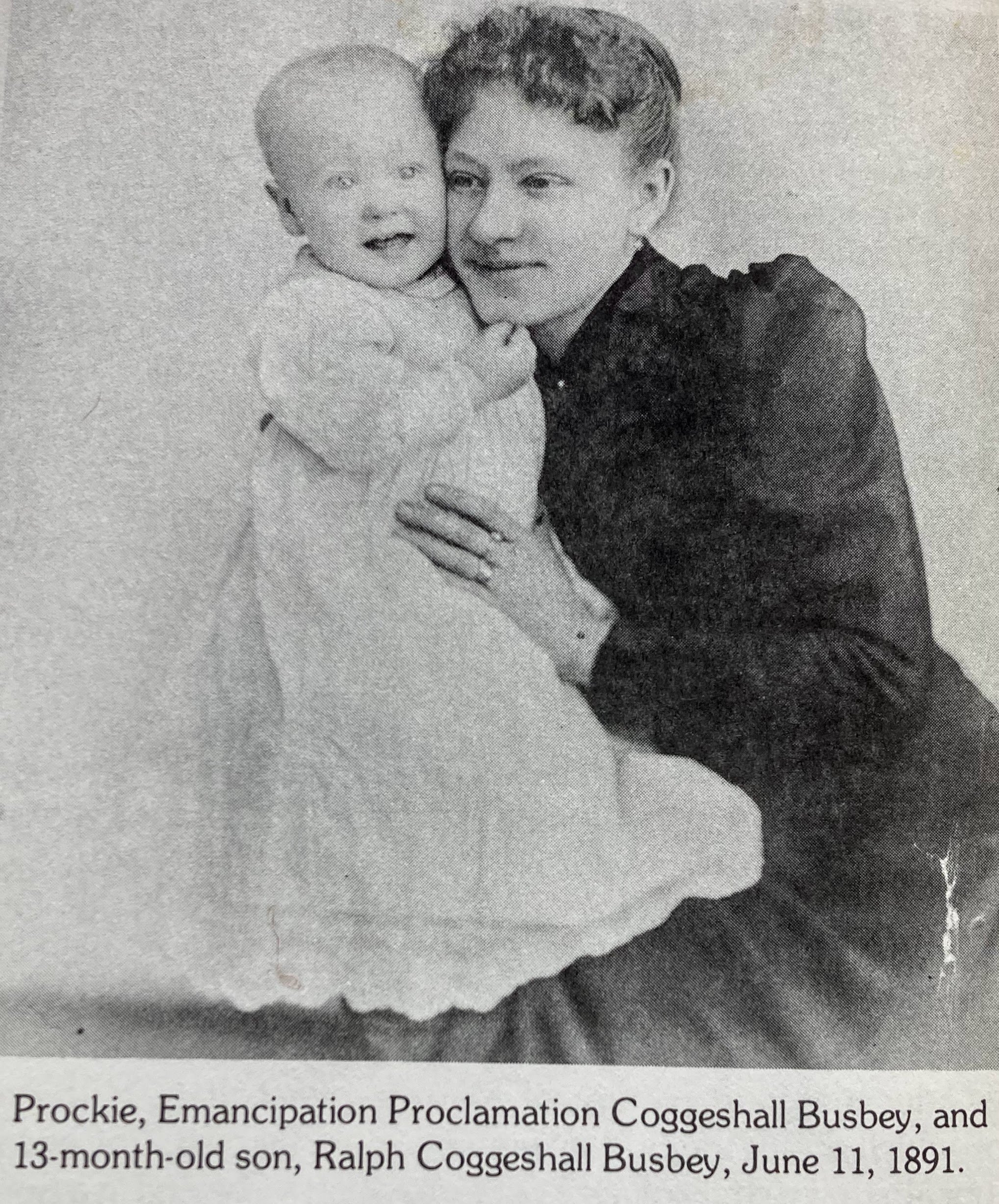
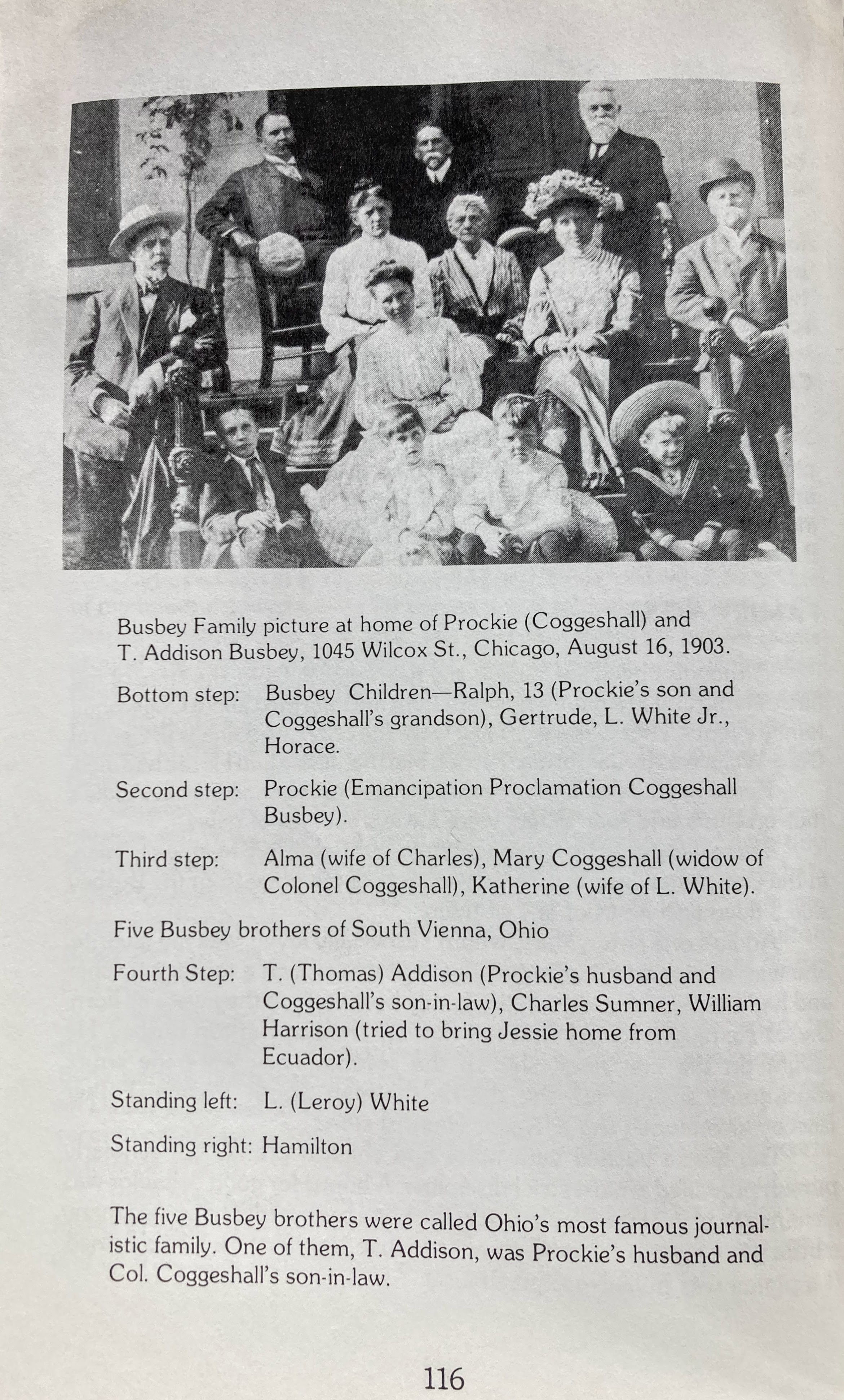
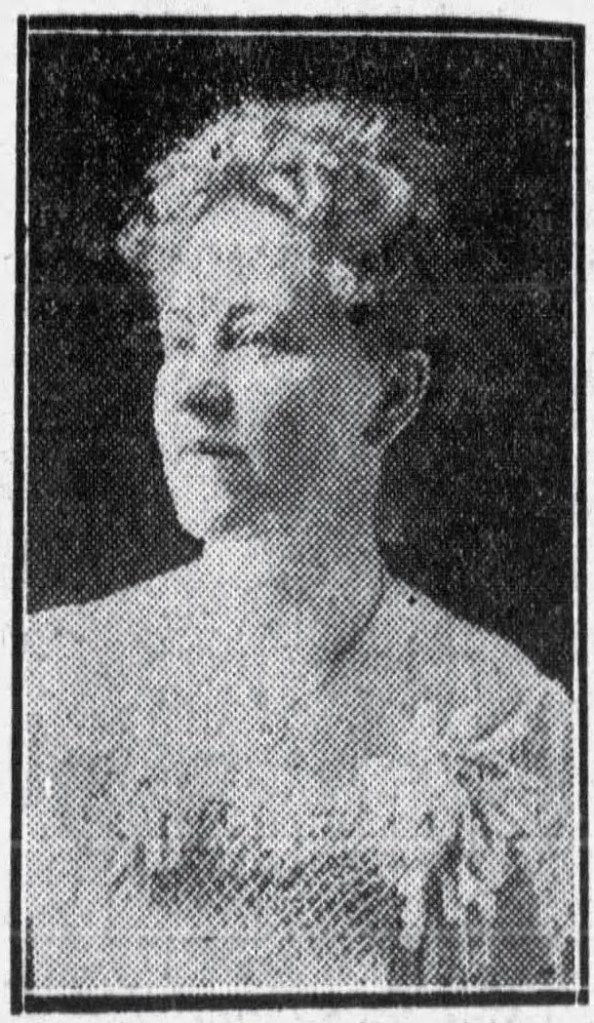
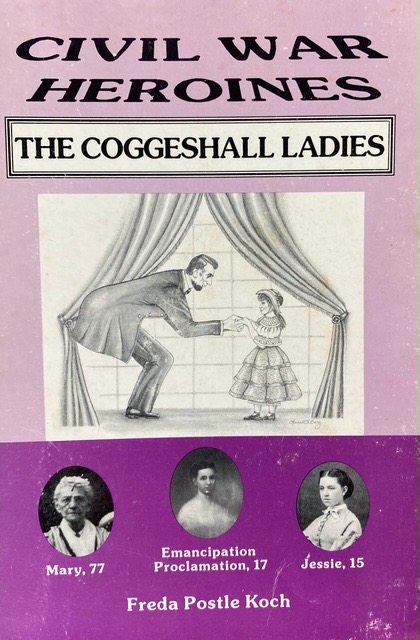
Photo credit above and below: the book Civil War Heroines, The Coggeshall Ladies. In this book, Prockie joked “Of course, my name is on Ralph’s birth certificate, all 40 letters of it–Emancipation Proclamation Coggeshall Busbey. It always made Ralph chuckle–and many other people, too.” Of her son’s middle name, she wrote “The Coggeshall was so that he would always know his heritage was from a famous diplomat, journalist and lecturer, my Father, Colonel William Turner Coggeshall.”
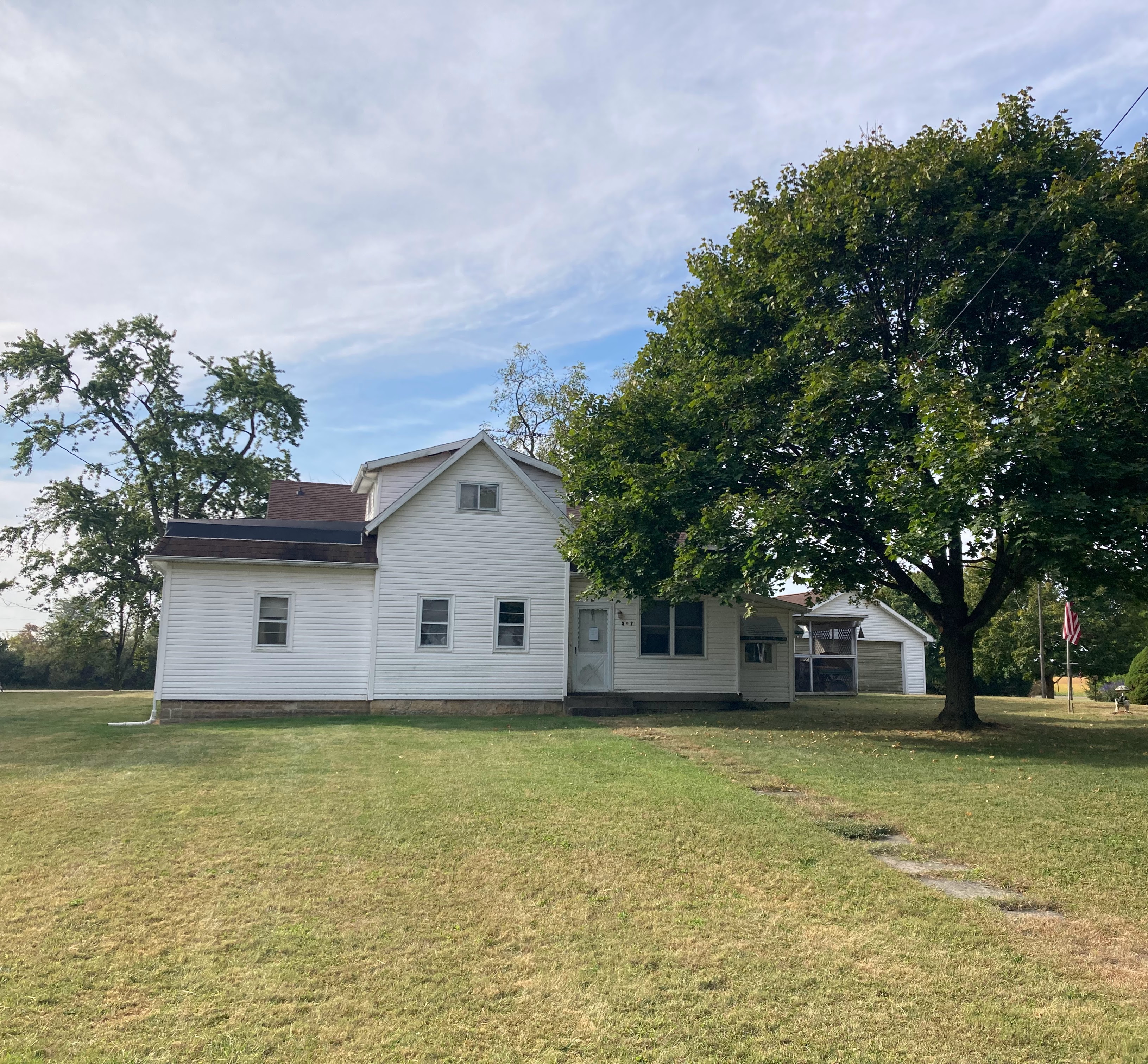
The Busbeys relocated to Thomas’ hometown of South Vienna (Clark County), Ohio, in 1908. They moved in with Prockie’s mother for whom they had purchased “a modest house” (per Prockie) on East Main Street. This is how it appears today and likely different from what it looked like in 1908.
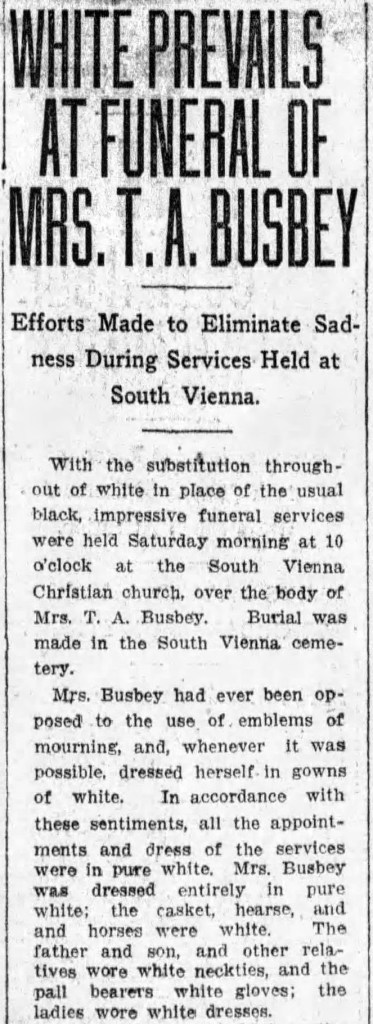
“The White Prevails at Funeral”
Springfield Daily News 10/1/1913.
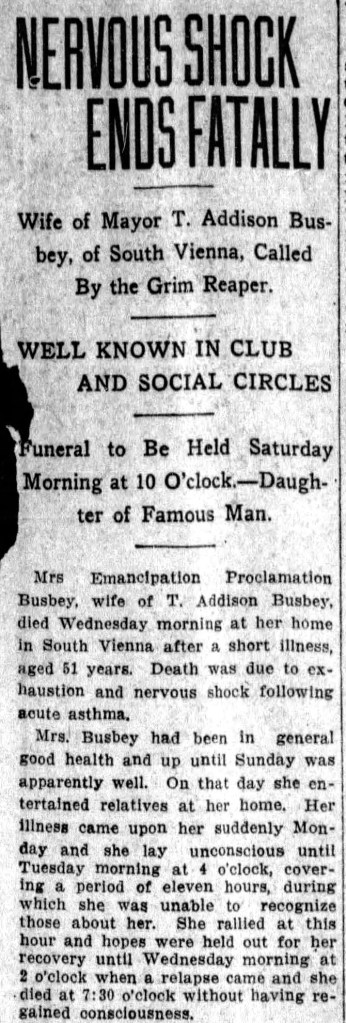
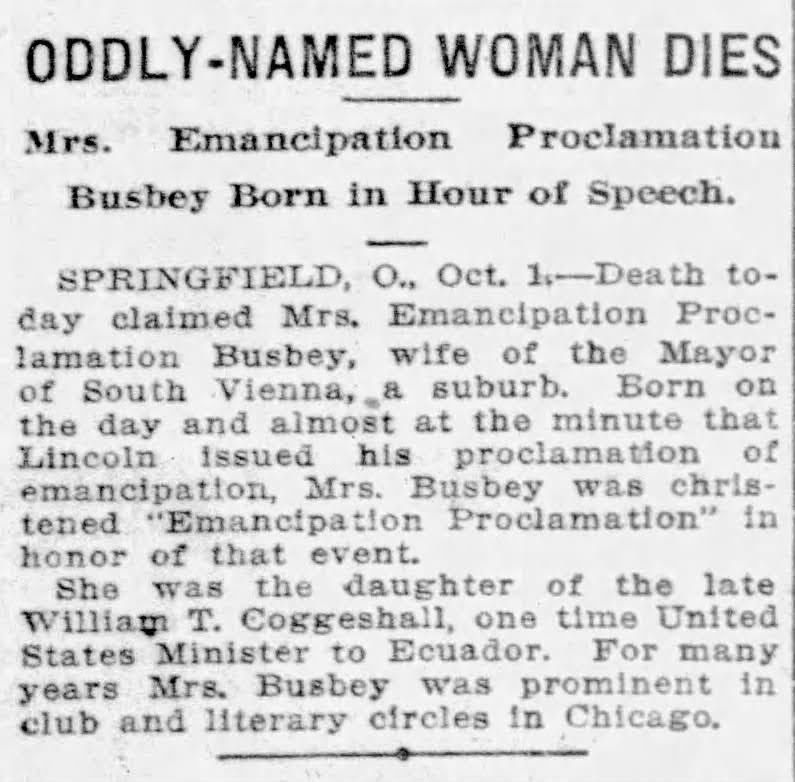
Prockie’s passing was published in many newspapers across the U.S. due to her unique name. The Morning Oregonian (Portland) 10/2/1913.
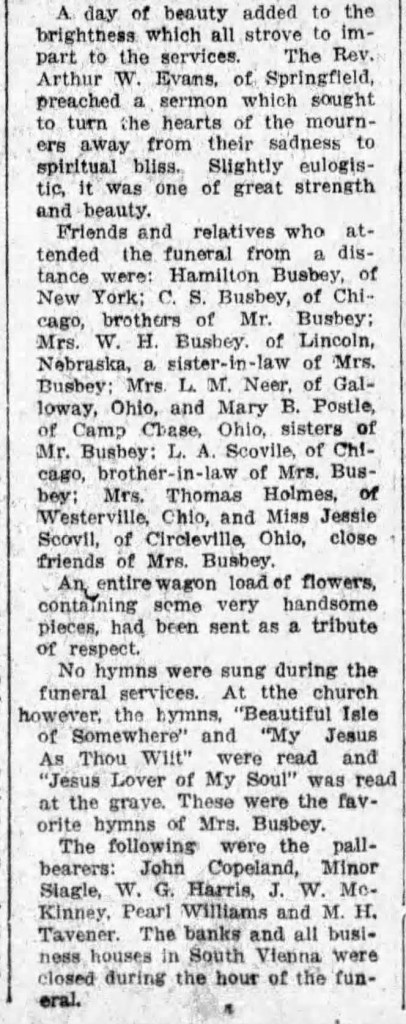
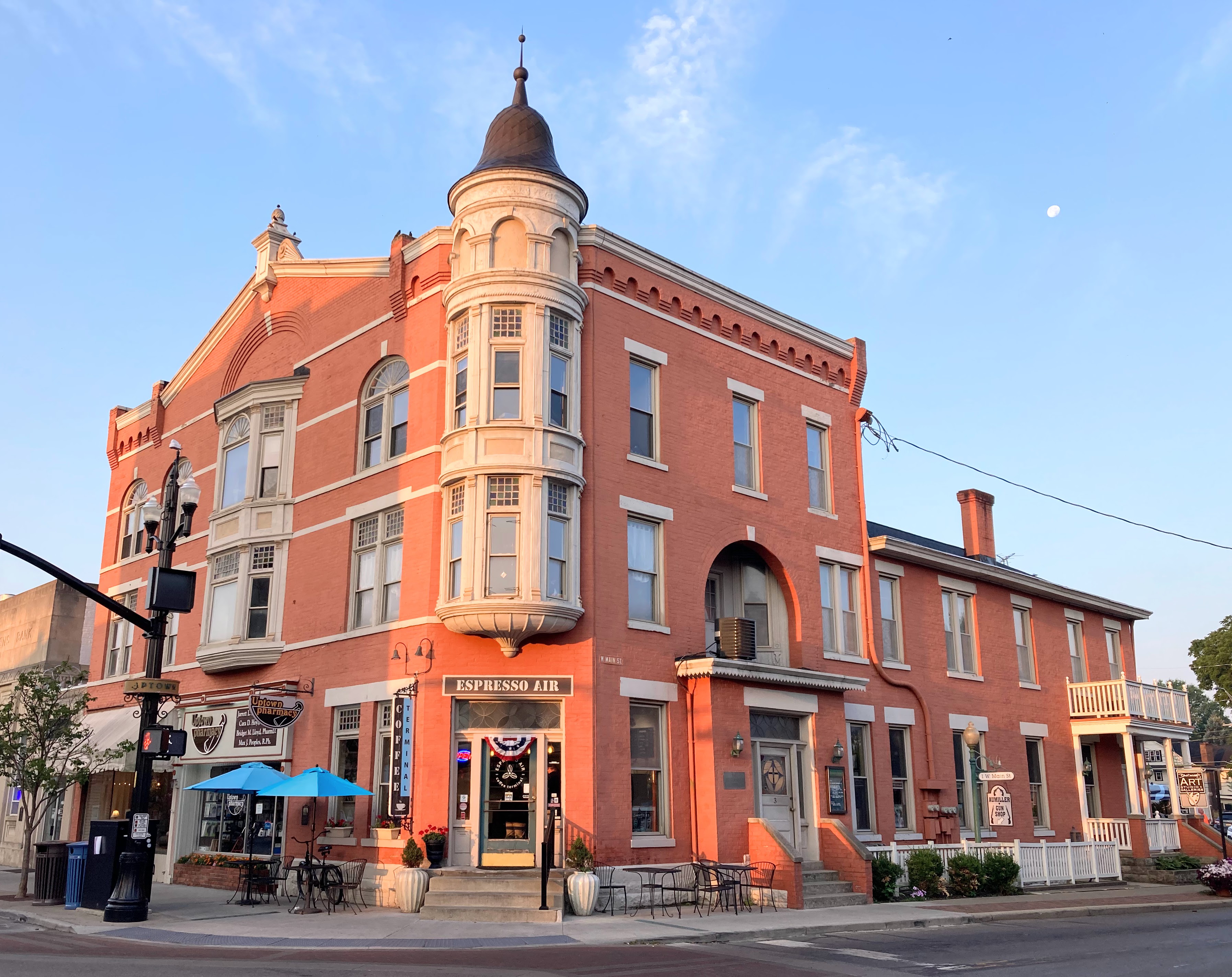
Springfield Daily News 10/5/1913.Note in the above article that Mrs. Thomas Holmes of Westerville (pictured here) attended the funeral. Mrs. Holmes often entertained in her home. It’s likely Prockie sang at these events. The Holmes built a hotel in Uptown Westerville which today houses Expresso Air Coffee, Uptown Pharmacy and various offices on the upper two floors. The Holmes’ North State Street house stands across from St. Paul Catholic Church. The purpose of adding these two pictures is to help emphasize that this vacant house is important to Westerville history and should not be torn down. It’s status is unknown.
Hotel Holmes.
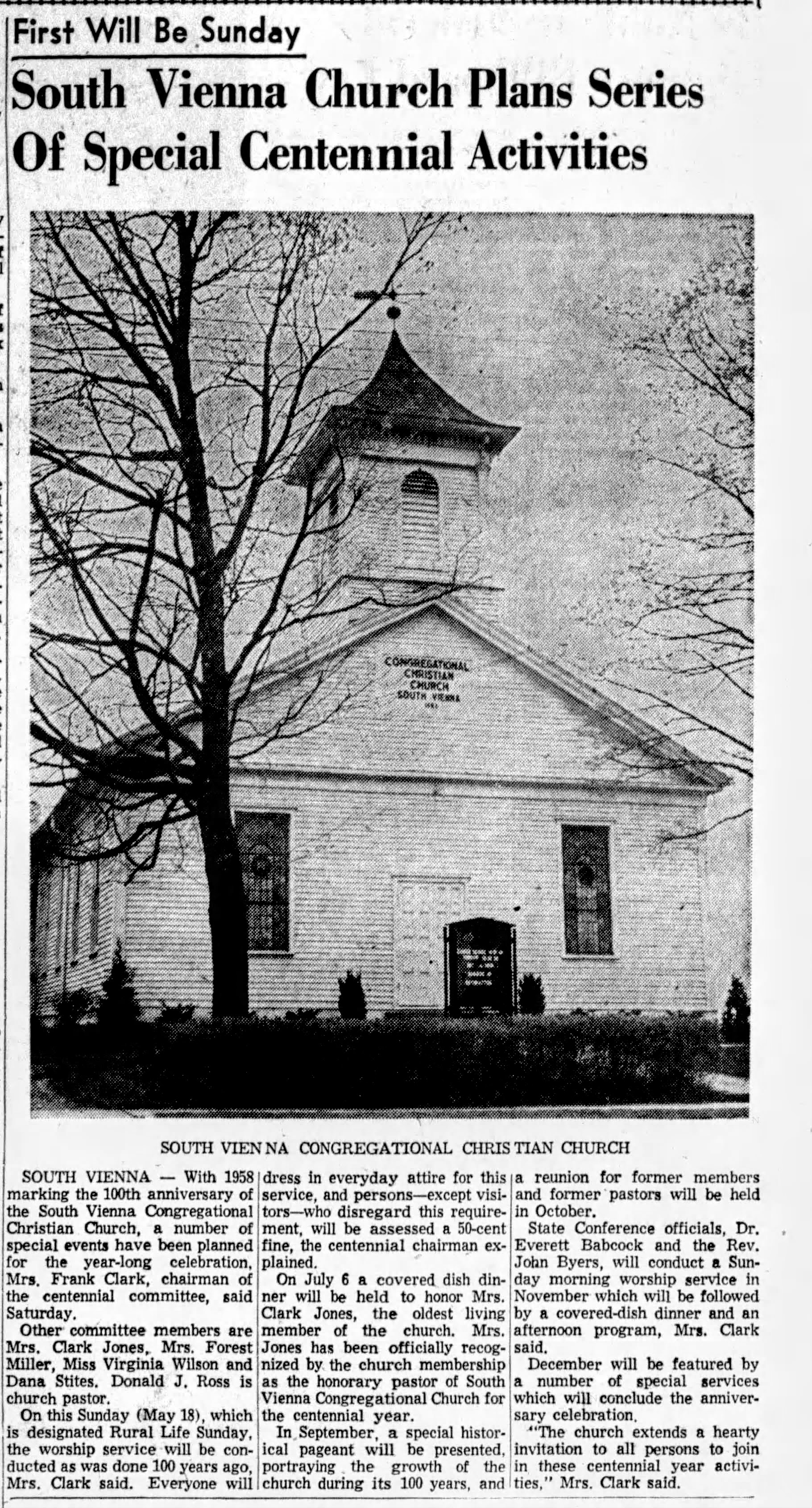
Prockie’s funeral was held here. The building no longer stands.Springfield News-Sun 5/18/1958. Photo credit: Clark County Historical Society at the Heritage Center, Springfield.
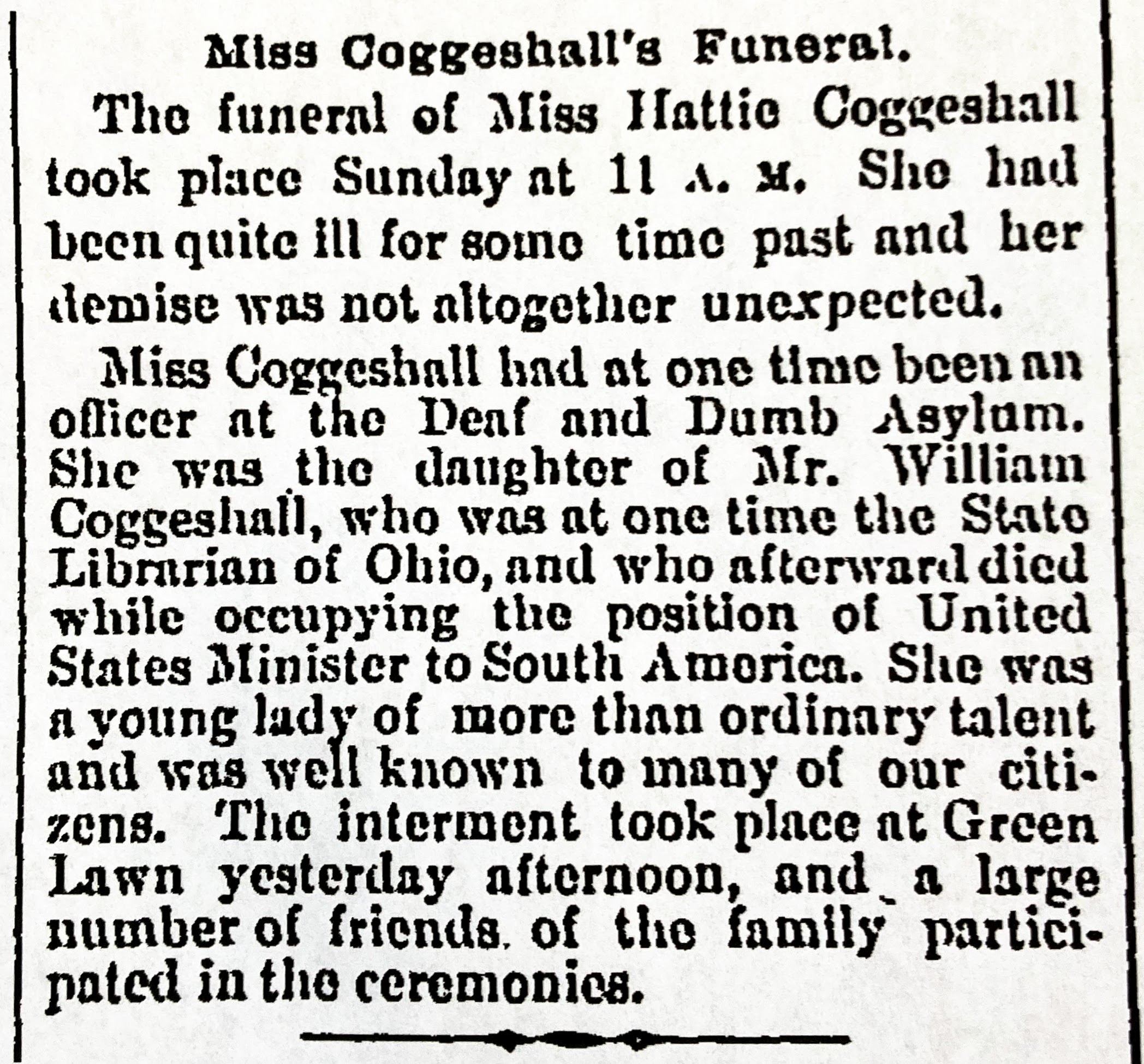
Hattie was listed as assistant to her mother in the 1880 U.S. Census. She must have moved back to Columbus sometime between then and her 1883 passing. The Columbus Dispatch 8/28/1883.
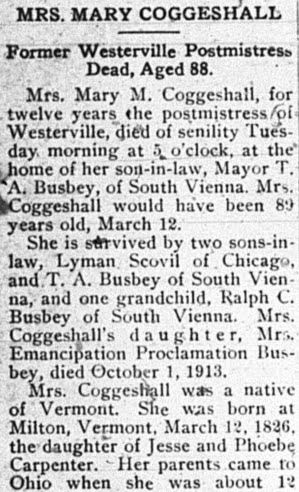
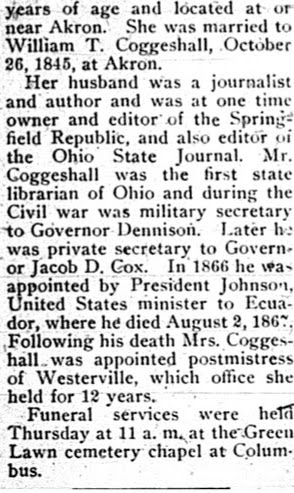
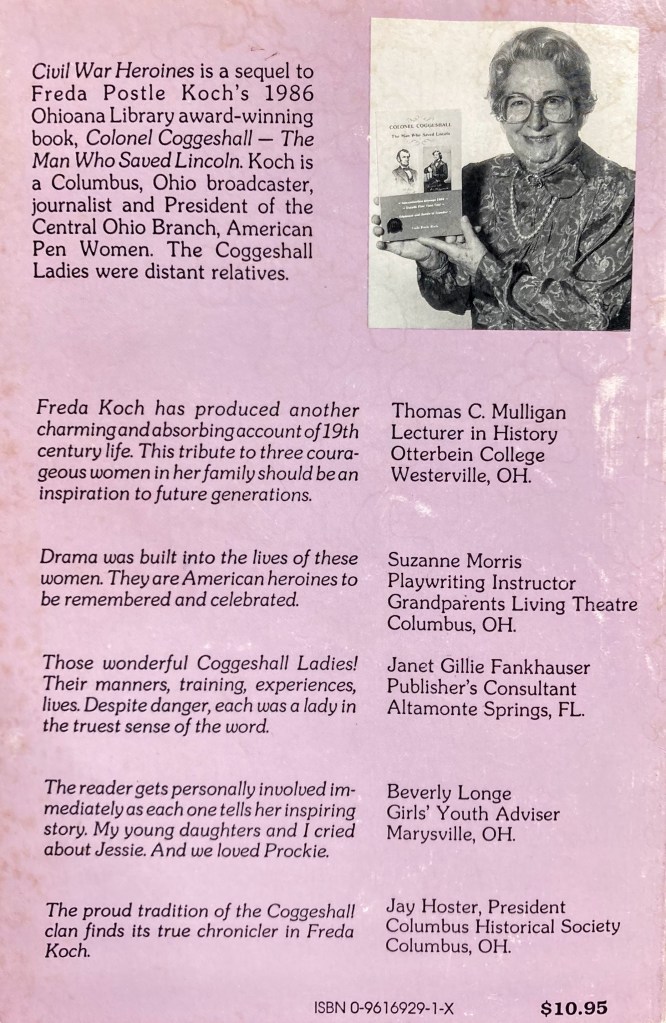
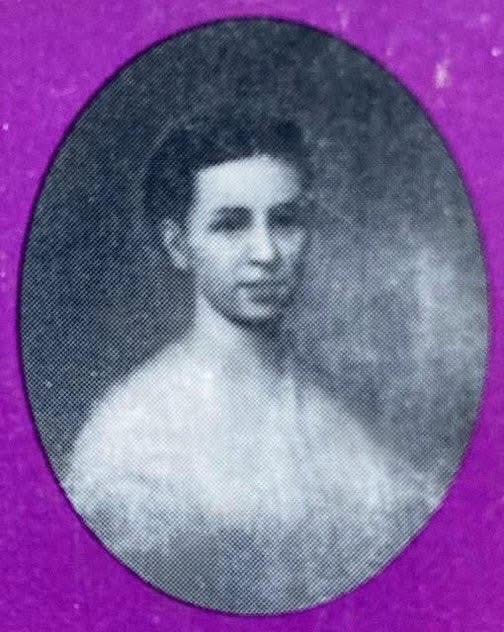
Mary outlived her 8 siblings, her husband and her 7 children. William, Mary and 6 of the 7 children are interred in the same plot at Green Lawn Cemetery in Columbus. Public Opinion 1/21/1915.Written in 1992. The author was second cousin to Prockie’s son, Ralph.Emancipation Proclamation “Prockie.” The photo on the book cover, enlarged. Enhanced by a Facebook photo restoration site.







 Histories and Mysteries